
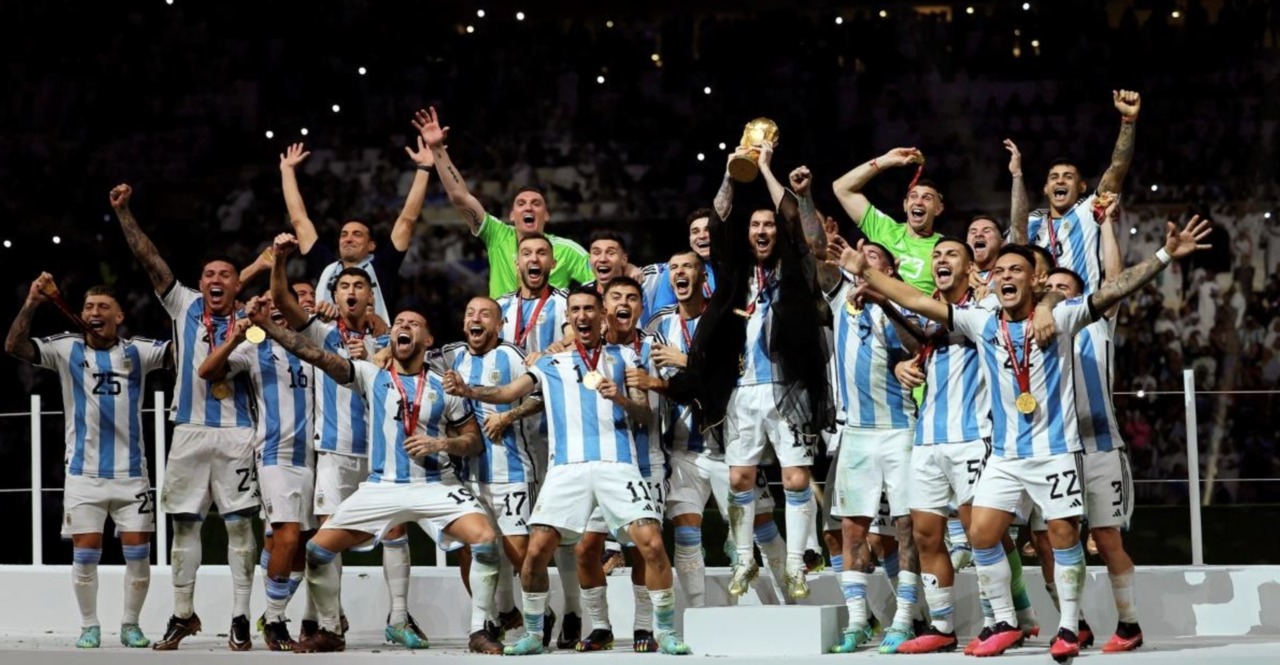
The final score tells us whether a team won. But by the time it appears, it is already too late to influence the game.
That makes winning a classic lagging indicator. Until the final whistle, anything can happen. The useful question is not simply, “Did we win?” It is, “Which actions during the game increased our probability of winning?”
From passion to performance data
To win, a team must create offensive pressure, resist the opponent's pressure, and convert opportunities into goals. I grouped match data into three broad dimensions:
Offensiveness
How consistently the team advanced, created shots, reached dangerous positions, and pressured its opponent.
Defensiveness
How effectively the team contained the opponent's offensive activity and reduced dangerous opportunities.
Effectiveness
Goals made divided by shots on target: a measure of how well real opportunities became results.
Balance
The combined interaction of offensiveness, defensiveness, and effectiveness across the match.
When the Balance Indicator was compared with the results, the winning teams had a value roughly ten times higher than the losing teams. That does not make the model perfect. It does show that the final result leaves a trail of observable behaviors.
The variable the model could not capture
France and Argentina made the limitation obvious in the final. The match remained tied through regulation and extra time even though the aggregate model favored Argentina.
There is something subjective and difficult to gauge: grit—the extra strength a team finds when everything starts going south.
Both finalists showed enormous grit. Sports will always contain elements that are not fully predictable. The model does not eliminate passion; it helps translate repeatable behavior into actions a team can influence before the game is over.
Performance influencers
At the 2019 SMRP conference, William Leahy, CMRP, presented the idea of the KPI as a Key Performance Influencer: an action or measure that can influence a future result. His work with the USCGA Bears hockey team helped move the record from 5 wins and 13 losses to 16 wins and 1 loss with the same team and a different operating method.
Using the same principle, ten World Cup match behaviors emerged as meaningful influencers. The percentages below reflect the observed advantage of winning over losing when the condition was met in the dataset:
Score first
463% observed win advantage.
More than 7 steals
225% observed win advantage.
Fewer than 5 turnovers
100% observed win advantage.
More than 5 shots on target
93% observed win advantage.
Pass completion above 87%
70% observed win advantage.
No goal conceded in the final 10 minutes
119% observed win advantage.
Fewer than 3 shots on target allowed
171% observed win advantage.
More than 13 shots
53% observed win advantage.
No goal conceded in the first 10 minutes
61% observed win advantage.
Fewer than 10 shots allowed
41% observed win advantage.
In the 64-match dataset, every team meeting eight or more of the influencers won. Every team meeting fewer than two lost. The sample is not a universal law, but the pattern illustrates how a final outcome can be broken into smaller controllable wins.
The asset-management parallel
Industrial organizations also need to translate distant goals into actions that can be completed today. Reliability, cost, risk, and production outcomes are lagging results. The daily work that influences them is often much smaller:
- Complete the work order with enough detail for the next person to learn from it.
- Report the actual failure mode rather than choosing the fastest available code.
- Perform inspections with attention instead of pencil-whipping the checklist.
- Protect schedule compliance and close the loop on defects.
- Recognize the early signals that move risk before a breakdown occurs.
Small wins build the result
Performance influencers provide a way to support success while there is still time to act. Passion matters. Grit matters. But disciplined daily behaviors give both of them somewhere useful to go.